

Inside Art 의 편집장인 Christopher Volpe 가 쓴 흥미있는 글이 있어 여기 옮긴다.
( 영어 원문은 맨 뒤에, 번역은 구글 번역으로 )
=======================================================
모네의 포플러 나무 연작에는 놀라운 이야기가 있습니다.
그가 전능한 예술의 신이었다는 것은 아닙니다(스포일러: 그는 전능했습니다).
하지만 클로드 모네는 에프트 강의 지류를 다른 곳으로 돌린 적이 있습니다.
헤라클레스 같은 영웅들이나 하는 일처럼 들리지만, 강을 다른 곳으로 돌리는 것은 모네가
무언가를 그리고 싶을 때 하는 일이었습니다.
1893년, 모네는 클로 노르망 강 하류에 땅을 매입했습니다. 이곳은 에프트 강(ɛpt라고 발음)이
지베르니의 센 강으로 흘러드는 곳입니다. 에프트 강의 작은 지류인 루 강을 파고 옮겨 연못을
조성했는데, 이 연못은 백합과 일본식 다리가 있는 그의 유명한 수생 정원이 되었습니다.
이렇게 예술가는 자신이 그리고 싶어 하는 멀리 있는 것들을 그리러 지구 반대편까지
여행하는 불편함을 피해 자신에게 오게 했습니다.
물론 그 정원은 이제 세계 유수의 박물관 벽에 가려져 있습니다.
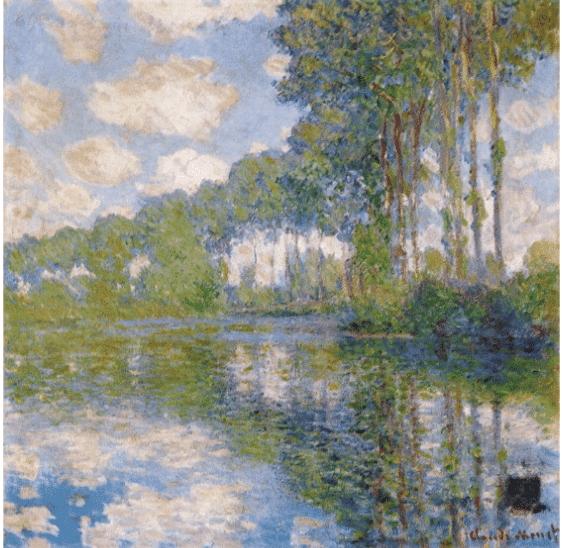
엡트 강 자체도 모네의 여러 작품에 등장하는데, 특히 그의 아름다운 포플러 나무 연작에서
두드러지는데, 이 연작의 제목은 종종 "렙트 강변의 사람들(Peupliers au bord de l’Epte)"에서
따온 것입니다.
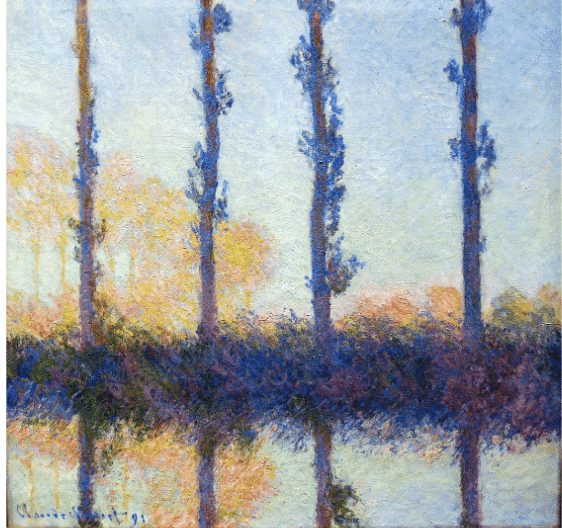
모네는 1891년과 1892년에 포플러 연작을 그렸습니다.
그는 이전에도 1875년에 '포플러가 있는 초원'에 이 나무를 그렸습니다.
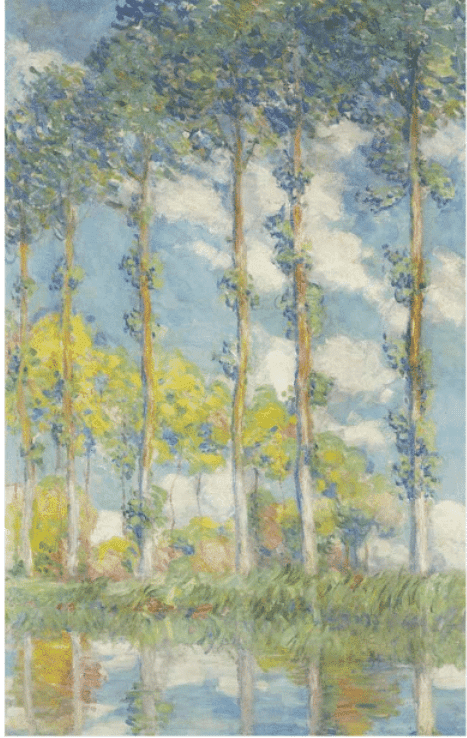
1887년에는 '햇볕 속의 포플러'라는 제목의 또 다른 연작을 그렸습니다(아래 사진 참조).
이 초기 그림들은 포플러 연작에 속하지는 않지만, 어쩌면 이 연작의 아이디어를 낳은
씨앗일지도 모릅니다.

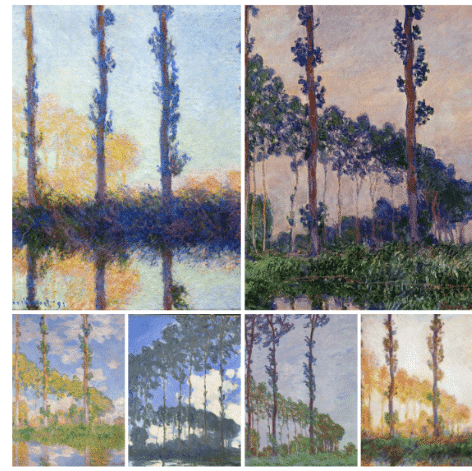
모네는 같은 나무를 다른 구도로 그린 세 점의 그림(결국 모두 최소 23점)을 작업하던 중,
나무들이 베어질 것이라는 소식을 접했습니다. 그래서 그는 자존심 강한 예술의 신이라면
누구나 할 법한 행동을 했습니다. 바로 그 나무들을 산 것입니다.
모네는 1891년 여름과 가을에 포플러 나무 그림들을 대부분 그렸습니다.
그는 강 상류에 정박해 둔 "떠다니는 작업실"로 노를 저어 가던 중 그 그림들을 보았습니다.
그림들은 엡트 강의 "S자 곡선"을 따라 일렬로 서 있었는데, 그림만 봐도 그가 왜 그 그림들에
푹 빠졌는지 알 수 있습니다.

리메츠 공동체 소유였던 이 나무들은 실제로 목재로 경매되었습니다.
모네는 그림을 완성할 때까지 나무를 오랫동안 보존하기 위해 어쩔 수 없이
이 나무들을 사들여야 했습니다. 연작을 완성한 후, 그는 나무를 원하는 목재 상인에게 되팔았습니다.
그래서 세상은 여전히 빛, 잎, 바람, 나뭇가지로 이루어진 우아하고 타원형의 기하학을 간직하고
있으며, 우리는 이를 위해 매우 단호하고 성공적이며 결코 포기하지 않는 한 화가에게 감사해야 합니다.
이 연작은 포플러를 묘사한다고 흔히들 말하지만, 사실 이 연작은 빛과 색,
그리고 그 사이의 관계에 관한 것입니다. 포플러는 모네가 이러한 요소들을 탐구하는 데
사용된 매개체일 뿐입니다.

하지만 그게 사실이라면, 왜 그는 그냥 아무 덤불이나 건초더미로 가득 찬 들판을
선택하지 않았을까요? 아, 잠깐만요. 그는 선택했습니다. "포플러" 연작은
모네의 "건초더미" 연작과 루앙 대성당을 하루 중 다른 시간대와 저녁 시간대에 그린
여러 그림 사이에 위치합니다. 건초더미와 대성당 사이에는 큰 차이가 있습니다.
어쩌면 나무들이 시골의 소박한 자연미와 도시 고딕 양식의 웅장한 건축물 사이에
중간다리 역할을 했을지도 모릅니다.
개인적으로 저는 그에게 나무가 주제로서 그렇게 중요하지 않았다는 것이 믿기지 않습니다.
어쨌든 그는 나무를 계속 보고 그리기 위해 기꺼이 돈을 냈으니까요.
이 포플러 그림에는 변함없는 매력과 우아함, 그리고 특별한 아름다움이 있는데,
다행히도 빛에 따라 피사체가 어떻게 다르게 보이는지와 같은 학문적인 탐구로는 결코 설명할 수 없습니다.

2015년 런던 국립미술관은 이 연작 중 다섯 점을 한 전시실에 처음으로 전시했습니다.
이 연작들은 런던에서 미국으로 순회 전시될 당시 필라델피아 미술관에도 전시되었는데,
당시 사람들은 이 그림들을 보기 위해 긴 줄을 서 있었습니다.
모네가 이 나무들에 그토록 열광했던 이유는 무엇이라고 생각하시나요?

There’s a surprising story behind Monet’s Poplars series.
Not that he was some sort of all-powerful art god or something (spoiler: he was), but Claude Monet once diverted a branch of the Epte River. Though it sounds like something only heroes like Hercules can generally be found doing, diverting rivers was just the kind of thing Monet did when he wanted to paint something.
In 1893, Monet acquired land at the bottom of Clos Normand, where the River Epte (pronounced ɛpt) empties into the Seine at Giverny. By digging and thus moving the Ru, a smaller branch of the Epte, he created the pond that rather efficiently became his famous water garden with its lilies and Japanese footbridge.
In this way, the artist made faraway things he liked to paint come to him, avoiding the inconvenience of traveling halfway round the world to paint them. That garden, of course, now winks from the walls of the world’s greatest museums.
The river itself (the Epte) also appears in a number of Monet’s works, most notably in his gorgeous series of poplar trees, the title of which is often given as some variation of Peupliers au bord de l’Epte.
Monet painted the Poplars series in 1891 and 92. He’d painted the tree before, in Meadow with Poplars painted in 1875. He did another one, titled Poplars in the Sun, in 1887 (shown below). These early paintings are not part of the Poplars series, but they might have, um, seeded the idea.
Apparently, Monet was at work on three paintings with different compositions of the same trees (in the end, there were at least 23 paintings in all) when he learned the trees were going to be cut down. So, he did what any self-respecting art god would do – he bought them.
Monet made most of the Poplars paintings in the summer and fall of 1891. He saw them while rowing toward the “floating studio” he kept moored further up river. They stood single file along an “s-curve” in the Epte, and you just have to look at the paintings to see why he fell hard for them.
The trees, which belonged to the commune of Limetz, were indeed auctioned off for lumber. Monet therefore was forced into buying the trees to keep them standing long enough to finish painting them. Once he’d completed the series, he sold the trees back to the lumber merchant who wanted them.
Thus the world still has that graceful, elliptical geometry of light, leaf, breeze and branch, and we have one very determined, and very successful, never-say-die painter to thank for it.
It’s often said that the series may depict poplars, but it’s really about light and color and the relationships between them. The poplars were merely the vehicle for Monet to explore these elements.
But if that’s true, why didn’t he just pick some random bushes or a field full of haystacks? Oh wait – he did. The “Poplars” series falls between Monet’s “Haystacks” series and his many paintings, at different times of the day and evening, of Rouen Cathedral. There’s a wide divide between a haystack and a cathedral; maybe the trees formed a halfway bridge between the humble natural form of the rural and the soaring architecture of the urban Gothic.
Personally, I find it hard to believe the trees meant so little to him as a subject. After all, he was willing to shell out for them just to keep looking at and painting them. There’s an undying charm and elegance, a special beauty to these Poplar paintings that academic concerns like how a subject looks different in different light will never, thank goodness, be able to explain.
In 2015, the National Gallery in London exhibited five paintings from the series, together for the first time in a single room. The paintings were also shown at The Philadelphia Museum of Art when the exhibition traveled from London to the United States, where people stood in long lines to see them.
Why do you think Monet was so crazy about these trees?


